Event 1
Death of Berenger the First
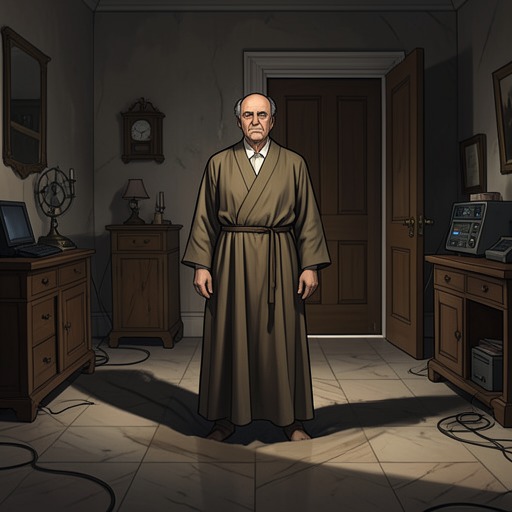
[Death of Berenger the First](entity:event-recall-event-death-of-berenger-the-f-82b420a1dab0) is presented not as a sudden physical collapse but as a staged passage from commanded movement to absolute stillness, and then from visible presence to absence. [Queen Marguerite](entity:character-recall-character-queen-marguerite-94aa7f37d7d8) directs [Berenger the First](entity:character-recall-character-berenger-the-first-cf94a4da8e87) through a sequence of bodily responses; his speech, heartbeat, and breath are declared unnecessary. The final scene then removes Queen Marguerite, the [Throne room](entity:location-recall-location-throne-room-1aac58b2ae8b), and the king himself, leaving only gray light. Death becomes both an event in the action and a carefully controlled transformation of the stage.
## The Body Brought to Stillness
The scene begins with Berenger the First close to the throne, while Queen Marguerite instructs him to turn toward her, look at her, and stand straight. Her commands make looking part of the process: he is told to face her and gaze through her, as if the encounter requires him to confront something that cannot return his gaze. She then directs him to give her first one leg and then the other. As she issues these orders, Berenger the First stiffens his legs. The body is still responding, but its response is no longer represented as free movement; it is becoming rigid under instruction.
The sequence proceeds from the legs to the fingers. Queen Marguerite asks for one finger, then two, three, four, and five, before extending the demand to all ten fingers. She next names the right arm and the left, then the chest, both shoulders, and the stomach. The inventory moves across the body in parts, turning an intimate human figure into a series of components that can be called forth one by one. By the end of this catalog, Berenger the First is motionless, compared in the stage direction to a statue. The change is visible before it is explained: the body that answered commands has become fixed.
## The Cessation of Life
Queen Marguerite presents that stillness as the completion of the process. She tells Berenger the First that he has lost the power of speech and no longer needs a beating heart or breath, treating the vital signs of life as requirements that have been dismissed. The phrasing makes death sound almost like the conclusion of a practical task: the preceding bodily demands have prepared him to take his place. The contrast is severe. The king has just been addressed through a detailed inventory of his limbs and organs; now those same bodily capacities are declared unnecessary.
This is not staged through a further visible struggle. Berenger the First is already motionless when Queen Marguerite identifies the loss of speech, heartbeat, and breath. The event therefore turns on a change in what his stillness means: first the result of following orders, it becomes the sign that bodily life has ended. The text does not supply a separate action of collapse or a medical explanation. Instead, the words and the fixed posture together establish the death, keeping the moment within the scene’s stark, ceremonial pattern of command and response.
## The Disappearance of the Throne Room
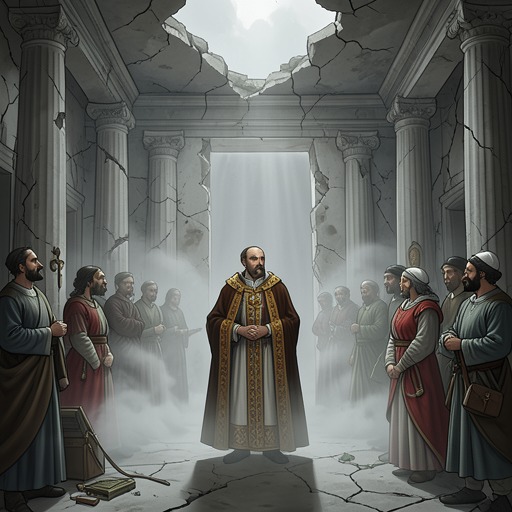
After Berenger the First is seated on his throne, Queen Marguerite suddenly disappears on the left. The stage direction marks this disappearance before the room itself has vanished, changing the scene’s visible arrangement while leaving the king momentarily present. The doors, windows, and walls of the Throne room are then to disappear slowly and gradually during the final scene. Their removal is explicitly marked as important: the setting does not simply change between scenes but is dismantled in front of the audience.
The sequence narrows what remains. First Queen Marguerite is gone; then the familiar enclosing features of the Throne room disappear. The king stays seated on the throne for a short time, visible in a grayish light after the room around him has been removed. The stage direction insists that this interval should last long enough for his remaining presence to register. Berenger the First and the throne then disappear as well, fading into something like mist. The order matters: the room’s boundaries are withdrawn before the ruler and the object associated with his position are erased.
At the end, nothing remains onstage except gray light. The stage directions emphasize both the marked character of the disappearances and their slow, gradual execution. This is not a quick blackout that conceals the transition. The audience is to watch the doors, windows, walls, king, and throne cease to be visible, one stage of absence following another. The final image therefore extends the death beyond the body: after Berenger the First disappears, even the architectural setting that framed his last moments is gone.
## The Death as a Theatrical Event
The scene links bodily extinction to the stripping away of visible supports. Berenger the First first loses the actions associated with a living body; then he remains briefly as a seated king after the room has dissolved; finally, neither the ruler nor his throne is left. The throne’s disappearance prevents it from serving as a permanent remainder of his authority, while the earlier removal of the room deprives his final presence of its ordinary setting. The sequence does not explain these changes naturalistically. It makes them legible through theatrical instructions that control how long each image persists.
The event’s dramatic force lies in that measured subtraction. Commands reduce the body to stillness; speech names the end of breath and heartbeat; stage action removes Queen Marguerite, the Throne room, and the enthroned king. Gray light is the sole remainder, not a new character or a surviving object. By ending with light alone, the staging carries the audience from the recognizable image of a monarch seated on a throne to an empty stage, making disappearance the final form of Berenger the First’s death.
Event 2
The Radiant City murder spree

[The Radiant City murder spree](entity:event-recall-event-the-radiant-city-murder-29338d63c9a1) is a daily pattern of deception and drowning: a killer posing as a beggar leads people to a pool, uses [Colonel's photograph](entity:object-recall-object-colonel-s-photograph-87ea91f890d7) to draw them close, and pushes them into the water. Its defining horror is the gap between knowledge and prevention. The method is displayed on walls and understood by people in the district, yet victims keep falling into the trap, the killer remains uncaught, and a new body can fall while the authorities discuss how difficult the murders are to stop.
## The Pool and Its Victims
The pool first returns to view as an unmistakable place [Bérenger](entity:character-recall-character-b-renger-189ac2d7e623) and [The Architect](entity:character-recall-character-the-architect-6b31973632ba) have already passed. The Architect says that two or three people are found drowned there every day. The report becomes immediate when Bérenger looks into the water: he describes a dead boy of five or six floating with his hoop, still clutching a stick, beside the bloated body of an officer in full engineers’ uniform. The Architect points out that there are three victims that day. Faced with the bodies, Bérenger tries to deny what he sees, calling it a plant in the water; the protest marks the distance between hearing about repeated deaths and confronting their physical reality.
The victims are not presented as a single exceptional case. The daily discovery of two or three bodies makes the pool a recurring site of violence, while the boy and the uniformed officer give the tally sharply different human forms. The scene supplies no personal histories for either victim, but their details resist reducing them to numbers: one is a small child with a hoop and stick, the other an officer who has drowned in uniform. The Architect’s matter-of-fact account and Bérenger’s effortful recognition place routine description beside visible death.
## A Murder Method in Plain Sight
The Architect lays out how the killer works. At the tram-stop, people get off to go home and walk toward the gates because private cars are not permitted outside the [Radiant City](entity:location-recall-location-radiant-city-0edce5495be7). The killer approaches disguised as a beggar, complains of hardship, and asks for alms. That appeal begins the encounter, but the killer continues by choosing a likely victim, striking up conversation, and persisting as the person walks on. He offers small goods from a basket: artificial flowers, birds, old-style nightcaps, maps, postcards, American cigarettes, obscene drawings, and other objects. The offerings are generally refused, yet the haggling keeps the chosen person alongside him until they reach the pool.
At the water, the killer brings out Colonel's photograph. The person leans closer to inspect it, particularly as darkness falls; the killer uses that moment to push the victim into the pool. The image is thus not merely an identifying clue but the bait at the heart of the attack. The sequence depends on ordinary movements—leaving the tram, walking home, stopping to look—and turns each into part of an engineered approach to the water. The victim’s curiosity supplies the opening the killer needs.
## Warnings, Evidence, and Failed Prevention
The murders are not secret in the district. The Architect says that pictures of the killer have been posted on walls, and that some information about the method has come from people found on the drowned victims’ bodies. Some victims have briefly been brought back to life and provided further information. The Architect insists that everyone in the district knows how the trap works, yet two or three people still fall into it every evening. Bérenger is astonished that people continue to be deceived; The Architect answers that the killer has never been caught in the act. Public knowledge has not translated into effective protection.
Bérenger proposes keeping a plainclothes inspector permanently at the pool. The Architect rejects the plan as technically impossible: inspectors are overworked and have other duties. He adds a further danger: an inspector would want to see Colonel's photograph too, and five inspectors have already drowned in that way. The evidence and the lure are therefore entangled. Trying to establish who the killer is can bring investigators within reach of the same temptation that endangers ordinary passersby, while the killer’s identity remains unproved and his whereabouts unknown.
## Another Death and the Scene’s Reversal
The account becomes a demonstration before it can become a solution. A cry sounds, followed by the heavy noise of a body falling into the water. Bérenger jumps to his feet and asks whether The Architect heard it. The Architect remains seated, biting his sandwich, and says that the killer has struck again. He explains that a moment of inattention is enough. His composure makes the event more disturbing: the discussion of a system that repeatedly takes lives continues alongside food and conversation, and the fresh sound of a victim falling does not interrupt the official’s detached manner.
The spree’s immediate consequence is not the apprehension of the killer but confirmation that he is still operating. The Architect’s account has made the mechanism legible, and Bérenger has proposed surveillance, but the audible fall shows that explanation and intention have not stopped the violence. The murders expose a grim contradiction within the Radiant City: the threat is visible enough to be described, pictured, and anticipated, yet it repeatedly escapes intervention. The pool returns as both crime scene and proof of that failure.
Event 3
The murder of Dany

[The murder of Dany](entity:event-recall-event-the-murder-of-dany-3283452c1a27) is the moment when the [Radiant City](entity:location-recall-location-radiant-city-0edce5495be7) killings become personal for [Bérenger](entity:character-recall-character-b-renger-189ac2d7e623): the victim is not an anonymous stranger but [Dany](entity:character-recall-character-dany-77442cad50d7), the former secretary he hoped would accept him. Her death also exposes the supposed safety of the [Civil Service](entity:organization-recall-organization-civil-service-d2a10e5d0af0) as conditional protection, and sets Bérenger’s anguished resolve against the Architect’s practiced acceptance of routine. The killing is heard rather than witnessed; its aftermath, reported in the language of procedure, becomes the scene’s central conflict.
## The Attack and Identification
Before Dany is identified, Bérenger has proposed placing a plainclothes inspector permanently at the spot. [The Architect](entity:character-recall-character-the-architect-6b31973632ba) dismisses the idea as impractical: inspectors are overworked, would also want to see the Colonel’s photograph, and five people have already been drowned. He adds that proving the Colonel’s identity would show them where to find him. The exchange makes the attack that follows feel at once predictable and uncontrollable. A cry rings out, then comes the heavy sound of a body falling into water. Bérenger jumps up to ask whether the Architect heard it; the Architect remains seated, biting his sandwich, and says that [The Killer](entity:character-recall-character-the-killer-6c3380a2923a) has struck again. The gap between the sound of a death and the ordinary gesture of eating establishes the scene’s stark contrast before the victim is known.
The Owner enters as an informer, and the news arrives first in a fragment: it is the blonde girl. Bérenger immediately asks whether it is Dany and cannot believe the answer. The Architect confirms her identity and explains that she was his secretary, now his former secretary. The scene therefore identifies the victim through her connection to the people present, not through any description of the attack itself. No one is shown catching The Killer in the act, and the evidence of the murder remains indirect: a cry, the fall into water, and the report that Dany is the latest victim.
## Liberty and the Civil Service
The Architect frames Dany’s death through the rule that The Killer does not attack the Civil Service. She had been protected while on his staff, he says, and he had warned her not to leave. Her departure in pursuit of “liberty,” in his account, removed that safeguard; he bitterly treats her fate as a lesson she has now learned. He says he expected the attack unless she had left the district as soon as she quit the Service. His explanation gives the institution’s protection a grim double character: it offers safety, but only so long as a person remains within its limits.
Dany’s choice is reported by the Architect, not heard from Dany herself. The scene supplies no account of her reasons beyond his claim that she wanted liberty, and her own voice is absent even as her decision shapes the event. That absence sharpens the contrast between the language of freedom and the fatal consequence attached to leaving a protected position. The killing does not establish that the Civil Service could guarantee safety in every circumstance; it shows the Architect treating continued membership as the condition that might have kept Dany safe, while acknowledging that she could also have escaped by leaving the district. Protection, in this telling, depends on where she belongs and where she goes, not on any action taken against the attacker.
## Bérenger’s Grief and Resolve
Bérenger’s response makes the loss intimate. He cries out in horror, calls Dany a poor girl, and laments that she had not had time to say yes to him. His words disclose the unfulfilled personal hope he had attached to her, while the repeated calls of her name and the stage direction of lamentation show grief overtaking ordinary speech. When he tries to appeal to the superintendent, he nearly sobs and crumples into his chair. Dany’s death thus changes the force of the killings for him: the pattern he had been discussing now includes a woman whose answer he was still waiting to hear.
The first response around him is procedural. The Architect tells the Owner to make the usual report, then phones in the death as another case: a young woman, Dany, who had worked with them. He reports that no one was caught in the act and that there are only suspicions, the same ones as before. He lays the telephone on the table and tells Bérenger to control himself, reminding him that everyone must die and that the investigation should take its usual course. The report records the case while also registering how little the routine has changed after repeated killings: the attacker remains uncaught, and the suspicions remain familiar.
Bérenger rejects that acceptance. He suddenly jumps up, insists that they cannot let things continue, and repeats that it has to stop. He runs out, slamming the imaginary shop door so loudly that the sound is heard, and continues to insist that something must be done. The exit converts grief into a declared intention to intervene, though the scene does not show what action he will take next. Behind him, the Architect watches from his seat, finishes his wine, and offers the Owner Bérenger’s untouched glass and sandwich. Dany’s death therefore ends not with a capture or a solution, but with Bérenger leaving the routine behind while the Architect resumes it.
## Dramatic Significance
The scene is built around the separation between hearing violence and seeing its consequences. The cry and fall arrive while the characters are occupied with how to prevent another attack; the victim is identified only afterward, and the audience learns her relation to them through the Owner’s report and the Architect’s explanation. This order turns a discussion of surveillance, workload, and proof into immediate personal loss without revealing The Killer’s identity or showing the murder itself.
Its decisive reversal is ethical as well as emotional. The Architect treats the Civil Service as a place of safety and Dany’s departure as the cause of her exposure; Bérenger instead takes the death as evidence that the existing response must end. The same event supports two opposed reactions: resignation to routine and a demand for action. The final image of the untouched wine and sandwich, consumed after Bérenger has gone, leaves that opposition unresolved. Dany’s death has made the crisis impossible for Bérenger to regard as merely another report, but the scene offers no confirmation that his resolve can stop the killings.
Event 4
Radiant City serial murders
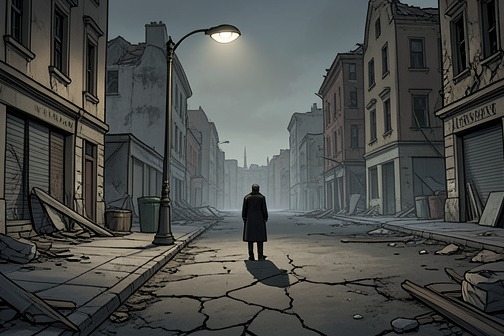
The [Radiant City serial murders](entity:event-recall-event-radiant-city-serial-mur-c591b6e48f62) transform a beautiful district into a landscape of fear and abandonment. The contrast between the district’s hopeful name and the violence within it becomes central to [Bérenger](entity:character-recall-character-b-renger-189ac2d7e623)’s account: an insatiable murderer has made the place hell, terrorizing and killing its inhabitants until the district itself seems close to vanishing. The murders are both a series of crimes and a force that empties the setting in which they occur.
## A district turned to terror
Bérenger introduces the [Radiant City](entity:location-recall-location-radiant-city-0edce5495be7) to [Édouard](entity:character-recall-character-douard-d95c38aa13b6) as a beautiful district he has just visited, one Édouard did not know existed. Its name promises brightness, but Bérenger immediately rejects any implication that it is a model or perfect neighbourhood. The district’s defining reality is instead the presence of [The Killer](entity:character-recall-character-the-killer-6c3380a2923a), whose repeated violence has made ordinary life precarious.
The threat is collective as well as individual. Bérenger says that The Killer terrorizes and kills everyone, and that the district is becoming deserted. His warning that it may soon cease to exist gives the crimes an unusually broad consequence: the murders do not merely claim victims but drive the population away and imperil the community’s continued life.
## The ruse and its recognition
Édouard recognizes the crime pattern before Bérenger has finished explaining it. He associates the murders with a beggar who shows people the [Colonel's photograph](entity:object-recall-object-colonel-s-photograph-87ea91f890d7) and, while they are looking, throws them into the water. In Édouard’s account, the photograph functions as bait: attention is diverted at the moment the victim becomes vulnerable. His familiarity with this method contrasts with Bérenger’s surprise that he already knows about the killings.
That recognition does not initially carry the same gravity for Édouard that it does for Bérenger. Édouard treats the affair as a trick for catching a fool and assumes Bérenger must mean something else. Bérenger, by contrast, stresses that the killings are turning the whole district into hell. Their exchange exposes a gap between knowing the method and grasping the scale of the danger.
## Evidence and the prospect of capture
The account later gains material support when Bérenger lays out objects associated with The Killer: an address, an identity card, and a photograph of him clipped to the Colonel's photograph. The juxtaposition links the man’s identity to the image used in the ruse. An address book containing the names and addresses of his victims further connects him to the people targeted in the murders.
Bérenger responds to these documents with growing excitement and insists that The Killer can be caught. The address book gives the list of victims a concrete form, while the identity card and photographs offer a line from the crime’s recognizable method to a named individual. The murders therefore shift, in Bérenger’s understanding, from a terrorizing pattern that empties the Radiant City toward a case with evidence that may make pursuit possible. The passage establishes that possibility, not the outcome of the pursuit.
Event 5
Dany’s murder
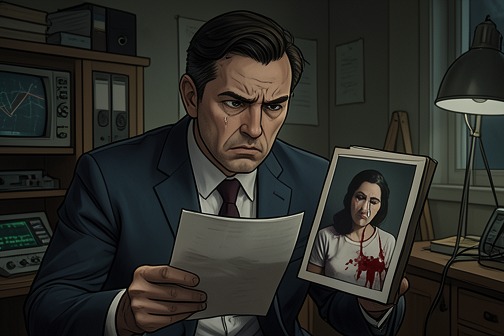
[Dany’s murder](entity:event-recall-event-dany-s-murder-fe9f93c4f87a) enters the play not as a staged killing but as a revelation in the papers left in [Édouard’s black briefcase](entity:object-recall-object-douard-a31194048efc). A diary connects the Killer’s method of attracting victims to [Bérenger](entity:character-recall-character-b-renger-189ac2d7e623)’s fiancée, [Dany](entity:character-recall-character-dany-77442cad50d7), turning a private loss into evidence of a wider pattern of preventable violence.
## Discovery of the Evidence
When the briefcase draws both men’s attention, [Édouard](entity:character-recall-character-douard-d95c38aa13b6) tries to take it for himself. Bérenger offers to help, then notices photographs among its contents and holds on to one despite Édouard’s efforts to hide the others. The struggle over the photographs changes the encounter: what had been an attempt to manage the briefcase becomes an investigation into its contents.
Bérenger subsequently opens a small box and lays out more documents, including a notebook. Its entries record the Killer’s intention to kill, describe an earlier victim pushed into a lake, and note periods when he had found no one to target. The objects that Édouard tries to reclaim thus make a written record of the killings and the process by which victims were selected.
## The Diary’s Link to Dany
The decisive connection appears in the diary’s account of persuading two people to look at the Colonel’s photograph near the pool, followed by a plan to persuade a young blonde woman to look at it. Bérenger recognizes the description as Dany, his fiancée. The text establishes her identification through his response; it does not describe the murder itself or give a date for it.
The diary places the reference to the young woman amid practical notes about finding potential victims, including entries about having no one to kill. Dany’s fate is therefore connected to the Killer’s deliberate, repeated method of approach rather than presented as an isolated or unexplained attack. The record makes the photograph part of that method: people are persuaded to look at it, and Bérenger understands the intended young woman to be Dany.
## Consequences of the Revelation
Bérenger declares that Dany will be avenged and treats the documents as sufficient proof to have the Killer arrested. His response shifts the scene from recognition and shock toward possible legal action. The evidence also prompts him to confront Édouard with the human cost of the failure to act: he says that many lives could have been saved.
The murder’s dramatic force lies in this reversal. Dany is first encountered through Bérenger’s grief and then named within the Killer’s own written account of his plans. The diary offers a route from personal loss to proof, while Bérenger’s accusation makes the discovery carry a second consequence: the documents suggest not only who was responsible, but how other deaths might have been prevented.
Event 6
Glamiss and Candor’s rebellion against Duncan
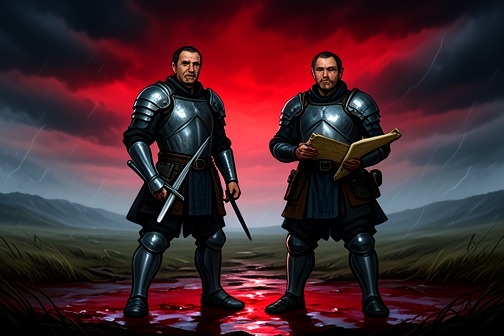
[Glamiss and Candor’s rebellion against Duncan](entity:event-recall-event-glamiss-and-candor-s-re-22a1fb9d80a3) is a failed-looking but unresolved bid for power: the conspirators plan to depose [Duncan](entity:character-recall-character-duncan-6b3e864f27b5) and divide the throne, yet the battle leaves [Candor](entity:character-recall-character-candor-e4f73ae0bdde) captive while [Glamiss](entity:character-recall-character-glamiss-551304ba39af) escapes with part of his forces. The episode’s starkly theatrical battlefield, rendered through gunfire, storm effects, a red sky, and isolated cries, makes military violence palpable without presenting it naturalistically; its later reversal denies the apparent finality of Duncan’s victory.
## The Alliance and Its Ambition
Glamiss and Candor approach one another and look toward the entrance of [Banco](entity:character-recall-character-banco-9e51f3038982), greeting him as a gallant general and great captain. This welcome places the rebel leaders in the company of a military figure whose presence matters to their challenge to Duncan. The exchange establishes the scene’s movement from a private alliance toward a larger contest involving armed forces, although the evidence does not describe Banco joining their plan at this point.
The rebels’ immediate objective is explicit. Glamiss proposes that they prepare weapons, gather men, and ready their armies for an attack at dawn; he expects Duncan to be beaten by the following evening and proposes that the victors share the throne. The timetable gives the conspiracy the form of a coordinated campaign, while the promised division of sovereignty identifies its political reward. This is not merely a protest against Duncan’s rule: the rebels intend to replace him and take the power they condemn.
Candor asks whether Glamiss truly considers Duncan a tyrant. Glamiss answers with a catalogue of accusations, calling Duncan a tyrant, usurper, despot, dictator, miscreant, ogre, ass, and goose, then makes the blunt claim that Duncan’s possession of power is itself proof. He presents his motives as honorable, but his own reasoning ties the charge of illegitimacy to the fact that Duncan rules, while his stated end is a share of the throne. The scene consequently sets the language of resistance against the rebels’ plainly stated ambition, without resolving the sincerity of either man’s political convictions.
## The Battle as Stage Event
The battle is represented after Glamiss and Candor leave in opposite directions, having sheathed their swords. A pause empties the stage. The directions then call for an extended transformation of light and sound rather than a naturalistic depiction of fighting: shots and flashes ripple across the scene, a conflagration appears in the sky, and a bright overhead light may be reflected onto the stage amid storm and lightning. The battle reaches the audience through theatrical signs of violence rather than through a narrated account of maneuvers or a visible sequence of combat.
As the sky clears, it turns red, described in the directions as beautiful and tragic. Machine-gun fire becomes less frequent and recedes; shouts, death rattles, and the groans of wounded people remain, followed by further shots and the shrill scream of a wounded man. The clouds clear onto a large deserted plain, and the man’s scream stops. After a short silence, a woman screams. The directions specify that this passage should continue for a long time and that its lighting and sound should remain nonnaturalistic, particularly toward the end. The prolonged transition from battle noise to deserted silence gives the apparent end of fighting an unsettled, staged quality rather than a simple report of victory.
## Apparent Defeat and Capture
The next scene announces that the battle is over. Blazing fanfares and cheering accompany Duncan’s entrance; [Macbett](entity:character-recall-character-macbett-d82fd6c896df) and Banco’s Head greet him, and Macbett says the danger has passed. Duncan responds with relief and asks whether Candor has been executed. Macbett says that Candor has instead been taken prisoner. Duncan questions why he was not killed and what is being awaited; Macbett answers that he is awaiting Duncan’s orders. Candor’s capture is therefore clear, but his fate is not yet settled: Duncan’s question makes execution an immediate possibility, while Macbett’s reply leaves the decision to the ruler.
The pause between the battle’s stylized violence and Duncan’s ceremonious entrance produces a sharp contrast. The previous scene has left a deserted plain, cries, and silence; the new one presents the ruler amid fanfares and cheering. Duncan treats the danger as past, but the prisoner’s status leaves a consequential decision open. The apparent victory is expressed through ceremony and control over Candor, not through a complete account of what became of every rebel force.
## Escape and Renewed Uncertainty
Later, as Duncan addresses Macbett and Banco about duties and obligations in return, an officer interrupts to report that Glamiss has escaped. The officer repeats the news and adds that part of Glamiss’s forces have rallied to him. Banco stops guillotining and comes downstage; the other characters jump up. His response emphasizes that Glamiss had been surrounded and seemed as good as taken, before he declares that there has been a conspiracy. The report thus reverses the earlier impression of an ended danger: one rebel leader is a prisoner, but the other has escaped with a regrouped portion of his forces.
The escape changes the battle’s consequence without erasing its losses or resolving Candor’s fate. Duncan had called the danger over, yet Glamiss’s renewed command makes that confidence premature. The rebellion’s aftermath is marked by an imbalance: Candor is under the ruler’s authority, while Glamiss remains at large with supporters. Banco’s interruption of the guillotining gives the news an immediate physical consequence onstage, and his suspicion of conspiracy directs attention from the battlefield’s apparent conclusion to continuing political danger.
Event 7
Execution of Candor’s army
The [Execution of Candor’s army](entity:event-recall-event-execution-of-candor-s-a-d64a938f28ff) turns a defeated rebellion into a mass killing staged as both state punishment and public entertainment. [Duncan](entity:character-recall-character-duncan-6b3e864f27b5) orders [Candor](entity:character-recall-character-candor-e4f73ae0bdde) and 137,000 of his soldiers put to death; [Banco](entity:character-recall-character-banco-9e51f3038982) works the [Guillotine](entity:object-recall-object-20c1d0f0b9f2), while [Macbett](entity:character-recall-character-macbett-d82fd6c896df) and [Lady Duncan](entity:character-recall-character-lady-duncan-de7d2807b162) are made to watch. The scene’s scale, ritualized speed, and deliberate spectacle expose the violence behind Duncan’s authority even as Candor gives that violence a bleak historical rationale.
## Background and Stakes
Immediately before the executions, Candor interprets his defeat as proof that History has sided against him. He says that victory would have made him an anointed king, whereas defeat makes him a traitor and coward, and concludes that “The logic of events is the only one that counts. [Historical reason](entity:concept-recall-concept-e1800669783e) is the only reason.” He calls the rebellion necessary as an example, even while describing himself as guilty and his life as an empty husk. His speech does not undo the defeat or offer an escape: it frames the execution as the final consequence of losing, and warns that people can know who is stronger only after the fighting is over.
Duncan presents the death sentence as justice, extending it beyond Candor to the soldiers of Candor’s army. His remark to Lady Duncan that “There aren't very many of them. 137,000—not too many, not too few” makes the number itself part of the scene’s bitter irony. A force of 137,000 is at once acknowledged as enormous and dismissed as manageable. Duncan also insists on speed: they are to finish by dawn. The order turns the defeated army into a problem of administration, measured by a deadline as well as by its head count.
## The Order and the Execution
Duncan first tells Lady Duncan that Candor will not be tortured, but put to death, teasing her with the promise of a more lavish entertainment. He then addresses the assembled company and declares the execution of the soldiers a demand of justice. After clapping his hands, he gives the order: “Go on. Off with his head.” The movement from private aside to public command makes the killing both a decision by the ruler and a performance for those gathered around him.
Candor’s last cry is “Long live the Archduke!” The salute does not prevent his execution; it accompanies it, leaving loyalty and defeat sharply juxtaposed at the Guillotine. Banco has already arranged Candor’s head on the device, having had to get rid of his ax to do so. The practical detail marks a change in his role: at this moment he is not using the ax but preparing and operating the instrument of execution.
The soldiers follow Candor in a continuous procession, one after another to the Guillotine. The stage direction notes that the same actors follow each other around, a theatrical means of making a vast execution playable as repeated movement. In the alternative staging proposed in the text, the scaffold and Guillotine could appear when Duncan gives the order; Banco would push a button, and the heads would fall. These are different staging possibilities, not additional events: both emphasize the mechanical efficiency with which Duncan’s command becomes killing.
## Spectacle and Witnesses
Banco urges the procession onward with “Hurry, hurry, hurry, hurry!” After each repetition, the blade falls, and the heads accumulate in the basket. The repeated cue compresses the execution into a relentless pattern: command, fall, and another victim. The growing pile gives physical form to the count Duncan has treated so lightly, while the rhythm makes mass death seem almost like a procedure that can be accelerated to meet a deadline.
Duncan directs Macbett to sit beside Lady Duncan and makes sure that both remain visible to the audience. The staging allows them to sit with their backs to the Guillotine and still appear to watch the executions. Lady Duncan counts heads. Her counting, set against the continuous procession and the rising pile in the basket, turns attention from the ruler’s abstract total to the succession of individual deaths; at the same time, it places the act of witnessing within the spectacle Duncan has arranged.
## Significance
The scene binds political victory to the power to decide who will be named a traitor and put to death. Candor’s account of historical reason treats the winner’s success as the logic that prevails; Duncan’s command supplies that logic with an immediate, physical consequence for the defeated. The rebellion’s failure is not merely announced but made visible in the execution of its leader and soldiers.
The contrast between Duncan’s calm instructions and the enormity of 137,000 deaths sharpens the scene’s indictment of authority. He speaks of justice, time, and numbers while Banco’s repeated actions carry out the sentence. By seating Macbett and Lady Duncan where the audience can see them, the staging also makes the watching of violence part of the event rather than a remote report. The procession, the basket, and Lady Duncan’s count show how spectacle can render mass killing legible—and how its orderly presentation does not lessen its brutality.
Event 8
Glamiss’s drowning

[Glamiss’s drowning](entity:event-recall-event-glamiss-s-drowning-340460005971) is an offstage death whose political consequences unfold in the Witches’ announcements: [Duncan](entity:character-recall-character-duncan-6b3e864f27b5) grants [Glamiss](entity:character-recall-character-glamiss-551304ba39af)’s title to [Macbett](entity:character-recall-character-macbett-d82fd6c896df) but keeps the lands for the crown, disrupting [Banco](entity:character-recall-character-banco-9e51f3038982)’s expectation of reward and turning a reported death into a test of loyalty, rivalry, and prophecy.
## The Death Reported
The play does not show Glamiss drowning. The First Witch announces his death to Macbett and later repeats the news to Banco: “Glamiss is dead. Drowned. The torrent swept him and his horse away.” The blunt repetition establishes the manner of death, while the torrent’s carrying away both Glamiss and his horse gives the report a forceful, compressed finality. The event reaches the audience through the Witches’ speech rather than through a witnessed scene.
The announcement unsettles both men because Glamiss’s death does not simply leave a vacant title. Before hearing the news, Macbett objects that Glamiss is alive and recalls that Duncan had promised the title and lands to Banco. Banco, too, understands that the title had been expected to be his. The report therefore changes the situation from an anticipated transfer to a disputed settlement, even though the death itself occurs outside the visible action.
## The Title and the Lands
[The Witches](entity:organization-recall-organization-the-witches-2c7b82cca8ad) describe Duncan as displeased with Banco for allowing Glamiss to escape, then predict that Duncan will exploit the circumstances: Macbett will receive the title, while the estates revert to the crown. In the later exchange, the [Second Witch](entity:character-recall-character-second-witch-371b27bf242a) makes the allocation explicit: Duncan will give Macbett the title of Baron Glamiss and retain all the lands. The division matters. Macbett gains rank, but not the property that would have accompanied the full grant Banco expected; Duncan’s decision strengthens the crown’s control over the estates while elevating Macbett.
Macbett confirms that the prediction has become policy when he enters calling for Banco. A messenger from the Archduke has summoned him to court, and Duncan has told him Glamiss is dead and that he is to inherit the title, “but not his lands.” Thus the death’s immediate consequence is not merely succession: it rearranges the rewards among the ruler’s followers and creates a choice Macbett cannot treat as a simple honor.
## Banco and Macbett’s Dilemma
Banco’s response reveals the personal cost of the transfer. He first questions how the Witches know what title was meant for him, then rejects their account of Duncan’s intentions. He insists that Duncan is loyal and keeps his promises, even as the Witches say Duncan is giving the title to Macbett. When they call Macbett his successful rival, the changed succession acquires an explicit personal dimension: Banco is not only denied a title but sees Macbett favored in his place.
Macbett, for his part, says he tried to persuade Duncan not to dispossess Banco. He recalls their friendship and Banco’s loyal service, but Duncan would not listen. Accepting the title may cost Macbett his comrade’s friendship; refusing it may incur the king’s displeasure. Macbett reasons that he obeys Duncan’s commands in war and therefore cannot easily reject a reward. His hesitation makes the political consequence of Glamiss’s death intimate: the settlement places [loyalty to the sovereign](entity:concept-recall-concept-ac69535e5e6f) against loyalty between comrades.
## Prophecy and Plot Consequence
The death gives the Witches’ predictions a first apparent confirmation. Macbett says they are beginning to come true, while also wondering how they could know Duncan’s decision and what chain of cause and effect might lead from this title to his eventual elevation. The play presents Glamiss’s drowning as both a concrete political change and the opening link in a future the characters do not yet understand. Macbett leaves without speaking to Banco, preferring to wait despite wanting to explain himself; the succession dispute therefore remains unresolved between the two men even as Duncan’s award takes shape.
Event 9
Conspiracy against Duncan

[Conspiracy against Duncan](entity:event-recall-event-conspiracy-against-dunc-2e6c83c8c104) is the moment when [Macbett](entity:character-recall-character-macbett-d82fd6c896df), [Banco](entity:character-recall-character-banco-9e51f3038982), and [Lady Duncan](entity:character-recall-character-lady-duncan-de7d2807b162) turn political dissatisfaction into a sworn plan to kill [Duncan](entity:character-recall-character-duncan-6b3e864f27b5). Its decisive tension lies between a claim to self-rule and Macbett’s intention to take the throne: the rebels speak collectively about governing themselves, but their proposed division of power already places Macbett above the others. The crossed daggers make their agreement a visible pledge, while the scene’s abrupt exit gives way to Duncan’s reappearance with real majesty.
## From self-rule to overthrow
The conspiracy begins with the language of political autonomy. Macbett names self-rule as the aim; Banco makes that idea practical by describing it as running their own affairs. Their exchange quickly hardens into a demand to drive Duncan out. Banco calls for his removal in emphatic, comprehensive terms, and Macbett echoes the demand before Banco states that they must overthrow him. The progression moves from an abstract ideal to a direct assault on the existing ruler.
Their descriptions of Duncan intensify that shift. The conspirators call him a tyrant, an usurper, and a dictator, reducing the justification for rebellion to the claim that his rule is illegitimate and oppressive. The labels are not accompanied here by a recounting of specific abuses; instead, their accumulation gives the plot its urgency and establishes the shared political language through which the three can act together. The subsequent oath to exterminate him makes explicit what the rhetoric has been moving toward: this is not merely a change of administration, but a plan to kill the sovereign.
## A hierarchy inside the alliance
Macbett’s proposal reveals that the promised new order is not a straightforward sharing of power. He suggests dividing the kingdom, but immediately specifies that he will take the throne. Banco is offered the position of chamberlain. When Banco reformulates this as second-in-command, Macbett corrects him: Banco would rank third, because the conspiracy has another participant. The exchange makes the hierarchy audible before the conspirators have taken power. Macbett treats the kingdom as something to partition and assigns the highest office to himself; Banco’s role is subordinate even within their common cause.
That third conspirator is Lady Duncan, whom Macbett calls indispensable. Her presence changes the conspiracy from a proposed arrangement between two men into a three-person alliance. Macbett also tells Banco that he and Lady Duncan are engaged. Banco recognizes her as the future Lady Macbett, congratulates the pair, and kisses her hand. The engagement is therefore disclosed within the political negotiation, joining a personal bond to the planned redistribution of the crown. The scene establishes her as a participant in the plot, not simply as the intended wife of its prospective ruler.
## The oath and its stage image
Lady Duncan’s declaration, “To the death!”, supplies the transition from planning to commitment. The three draw their daggers and cross them at arm’s length, turning their agreement into a compact that can be seen as well as heard. Their collective vow to exterminate Duncan follows the gesture. The daggers make the conspiracy’s intended violence tangible, while the shared action presents the three as joined in a common undertaking. The staging gives the oath a formal, almost ceremonial shape, though its purpose is regicide.
The alliance remains sharply unequal even at the instant of mutual commitment. All three participate in the oath, but Macbett has already claimed the throne and placed Banco below Lady Duncan in the proposed order. Their solidarity rests on a common target, not on an equal distribution of authority. The scene thus holds two political meanings together: collective resistance to Duncan and a prospective concentration of power in Macbett’s hands. The promise of self-rule does not erase the ambitions revealed by the conspirators’ own terms.
## Exit and contrast
After the oath, fanfares sound and the conspirators leave quickly to the left. The stage direction marks the end of their private agreement with a swift departure; it does not show them carrying out the killing, and the conspiracy should not be confused with Duncan’s later assassination. The Archduke enters from the right, and the scene notes that Duncan has real majesty, at least at its beginning. That immediate contrast places the conspirators’ accusations beside the ruler’s stage presence. Their plot has been established, but Duncan is not presented in this moment as already stripped of authority: the grandeur they mean to overthrow remains visible as the next phase begins.
Event 10
Duncan’s assassination
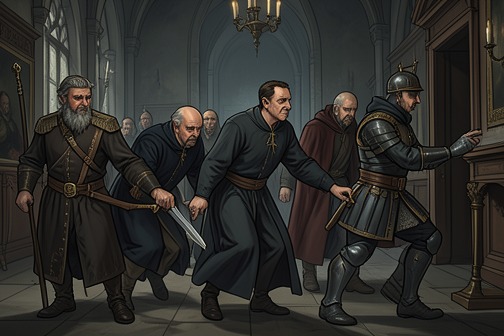
[Duncan’s assassination](entity:event-recall-event-duncan-s-assassination-c04f560e592b) converts a staged ceremony of royal healing into a coup enacted in front of its intended victims. [Banco](entity:character-recall-character-banco-9e51f3038982), [Lady Duncan](entity:character-recall-character-lady-duncan-de7d2807b162), and [Macbett](entity:character-recall-character-macbett-d82fd6c896df) enter disguised among the sick, reveal themselves together, and close around [Duncan](entity:character-recall-character-duncan-6b3e864f27b5) as he retreats toward his throne; the blows they strike make the language of accusation part of the killing itself.
## The Healing Rite Becomes an Ambush
Duncan calls for the patients to be brought in, and the ceremony proceeds as a solemn public ritual. After the eleventh sick man, the tempo slows and the music fades. Two final patients enter from opposite sides in long hooded capes. One creeps behind the Officer, who has been calling for the next patient but fails to notice the approach. The procession has thus concealed the conspirators in the very line of people Duncan expects to receive his healing touch.
## Disguise and Recognition
The ambush breaks open when the music suddenly stops. At the same instant, the monk throws back his hood or removes his mask, revealing Banco, who draws a long dagger. Duncan’s single-word response, “You?”, registers recognition before he can recover from the surprise. Lady Duncan also casts off her disguise and stabs the Officer in the back, while the other hooded beggar, Macbett, draws a dagger of his own. The attackers have not merely entered the ceremony unseen: they have occupied its roles, then discarded them together, turning the healing rite’s expected sequence into a coordinated assault.
Duncan’s question to Lady Duncan—“You, madam?”—makes the second revelation a betrayal within the royal household as well as a political attack. The Officer falls, and Duncan calls the three conspirators “Murderers!” Banco answers by calling Duncan “Murderer!” Duncan repeats the accusation, so that the exchange does not settle who has the moral claim; instead, it makes the killing a confrontation in which each side names the other as guilty. The accusation becomes the scene’s refrain even as the conspirators move from revelation to action.
## The Circle Closes Around the Throne
Duncan backs toward the throne as the three attackers slowly tighten their circle around him. The movement turns the throne from the center of a healing ceremony into the destination of a retreat: Duncan tries to ascend, but the conspirators keep closing in. Lady Duncan snatches off his cloak. Without it, he feels naked and exposed, and he backs up the steps trying to cover his body with his arms. The gesture leaves him struggling to protect himself even as the symbols of royal authority are about to fall away.
Duncan does not get far. His scepter falls in one direction and his crown in the other; Macbett pulls him down. The objects that marked his kingship are separated from him in the same action that brings him to the ground. Banco strikes first, shouting “Murderer!” Macbett stabs Duncan a second time, and Lady Duncan delivers a third blow, each repeating the accusation. Duncan’s own cries of “Murderers!” continue after the three attackers have stood over him, growing quieter and then feebler. The repeated word persists as his power and voice diminish, until the coup has made the accusation physical and the king is dead.
## The Intimate Aftermath
After the three conspirators draw apart, Lady Duncan remains beside the body, looking down at her dead husband. Her response shifts the scene from the public struggle over kingship to a starkly personal association: she says that Duncan now looks just like her father, whom she could not stand. The remark does not undo her role in the killing—she has joined the attack and delivered one of its blows—but it makes the aftermath more than a simple image of political victory. The newly dead king is also her husband, and in death he becomes inseparable, in her perception, from a father she rejected. The coup ends not with reconciliation or a claim of triumph, but with Lady Duncan alone beside the body and an unresolved disclosure of hostility.
Event 11
Macbett’s coronation and wedding
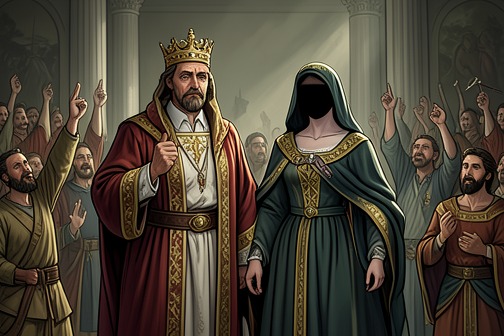
[Macbett’s coronation and wedding](entity:event-recall-event-macbett-s-coronation-an-97ae9a16711b) present a violent seizure of power as a triumphant public union, then reveal that the bride is a witch wearing [Lady Duncan](entity:character-recall-character-lady-duncan-de7d2807b162)’s appearance. The ceremony’s crowns, robes, scepter, and cheering crowd lend the new regime a polished image of legitimacy; its immediate aftermath strips that image away, exposing both the impersonation and the coercive ambition behind the throne.
## Prophecy and the Road to Power
The pageant answers a promise made by the First Witch: [Macbett](entity:character-recall-character-macbett-d82fd6c896df) would become Archduke and rule the country, and would ultimately be king. He protests that he is not ambitious, presenting service to [Duncan](entity:character-recall-character-duncan-6b3e864f27b5) as his only aim. The [Second Witch](entity:character-recall-character-second-witch-371b27bf242a), however, warns that Duncan will take advantage of him by granting him a title while keeping the lands for himself. The prediction thus finds leverage in Macbett’s loyalty: his stated devotion to the sovereign sits beside a grievance that can be turned toward advancement.
[Banco](entity:character-recall-character-banco-9e51f3038982)’s response makes the prophecy politically dangerous rather than privately reassuring. He recognizes the witches as spies working for Duncan’s enemies and tries to run them through with his sword. As they escape in opposite directions, the First Witch again declares that Macbett will replace Duncan, and the Second confirms that he will mount the throne. Banco’s failed attempt to stop them leaves the prediction in circulation, while his later appearance at the wedding feast will give that earlier resistance a spectral return.
The immediate inducement to violence comes from Lady Duncan’s dagger. She offers it as the instrument of Macbett’s ambition and their rise, urges him to act boldly, and promises that he will take Duncan’s place beside her. The blade is imagined not merely as a means to power but as a lasting reminder of success and a spur to further deeds. Macbett hesitates even as he calls her a siren; her persuasion makes desire, ambition, and political ascent part of the same bargain. At the wedding feast, Lady Duncan will identify Macbett as the murderer of his master and friend, revealing what the celebratory union has concealed.
## The Public Coronation and Wedding
After a blackout, the scene opens on shouts acclaiming Macbett and the bride. They enter in robes of state, crowns, and purple robes; Macbett carries his scepter. Bells ring as the crowd cheers, and the pair stand at center stage with their backs to the audience, waving toward the spectators on either side. They turn, salute, wave, and blow kisses. The choreography presents rule as a performance for a watching public: the new sovereigns display themselves, while the crowd’s acclamation supplies the sound of consent.
The bride is hailed as the Archduchess, and Macbett’s exchange with her hints that the spectacle rests on arrangements he has already discovered. He tells her that they will discuss matters later; she replies that she can explain, but not in public. He says he has canceled her prediction, discovered her arrangements, and taken steps to prevent her from having the upper hand. Their smiles and continued greeting of the crowd keep the public image intact, even as their private words suggest distrust and a struggle over who controls the outcome. The stage does not resolve this dispute in the ceremony itself; instead, it lets the carefully maintained display proceed under the shadow of what the pair know.
## The Bride’s Disguise
After the couple leave, the apparent bride returns with her Lady-in-waiting, still in the ceremonial costume. The attendant praises her bearing and the couple’s appearance, but the bride says Macbett has fallen asleep after drinking too much and that the wedding feast is still to come. She then discards the sacred crown and removes the cross she had worn, saying that it has been burning her and that she has doused the wound with curses. The objects that had just certified her public status become, in private, things she cannot bear to wear.
Her account of the ceremony turns its sacred gestures into ordeals she endured for the disguise. She says the white dress burns as well, that she spits out the Host that stuck in her throat, and that the icons nearly made her faint when she was required to touch them. She even kissed one, describing the act with disgust; strong, spiced magic vodka, by contrast, is to her no more than mineral water. These details make the wedding’s religious signs instruments of concealment: the apparent bride has performed reverence while inwardly rejecting the objects and rites that made her seem an appropriate sovereign consort.
The Lady-in-waiting helps her change back into a witch’s costume. The transformation is made materially visible through an old, foul-smelling dress, an apron covered in vomit, dirty gray hair, false teeth, and a pointed nose. The First Witch urges haste, and the Second Witch says she is hurrying. Their exchange confirms the impersonation as a coordinated deception rather than a mistaken resemblance. One of them concludes that Macbett will no longer be able to escape the arrangement, while the other says that the boss will be pleased. The bride’s public likeness to Lady Duncan has served the ceremony; the change of clothes exposes the machinery behind that likeness.
## Exposure at the Feast and the Ceremony’s Reversal
The wedding feast brings the concealed truth into the same public space as the new regime’s celebration. Banco suddenly appears in a doorway and advances; his arrival recalls the man who had tried to attack the witches when he first heard their prophecy. The apparition interrupts Macbett’s claim to rule without opposition. Later, when Macbett invites the woman he believes to be his wife to take the place of honor, a guest acclaims Lady Macbett, but she rejects the name: she declares herself Lady Duncan, the unhappy but faithful widow of the rightful Archduke.
Macbett insists that she is his wife and appeals to the guests’ presence at the wedding. Lady Duncan distinguishes the ceremony they witnessed from her own marriage: Macbett, she says, married a sorceress who had taken her face, voice, and body. The witch imprisoned her in the palace dungeons, but her chains have just fallen and the bolts drawn back as if by magic. She refuses complicity with Macbett and calls him an usurper and imposter, as well as the murderer of Duncan. The crowd’s recollection of the wedding cannot undo her account; instead, it demonstrates how effectively the impersonation passed before witnesses.
Macbett asks how Lady Duncan knows what has been happening, while a guest echoes the question. The interruption leaves the exposure unresolved as an explanation but decisive as a political and personal reversal: the woman presented as his bride refuses the role, and the wedding’s apparent union is shown to have been a witch’s performance imposed upon an imprisoned widow. The later forest procession sharpens the irony of Macbett’s confidence. When [Macol](entity:character-recall-character-macol-eb661833d4a2) confronts him, Macbett still insists that he can be beaten only when the forest marches against him; people then approach carrying placards with trees, and Macol announces that the forest is on the march. The ceremony that advertised a secure new order therefore stands within a sequence of false appearances and overturned predictions, not as a stable settlement.
Event 12
Macbett’s murder of Banco

[Macbett’s murder of Banco](entity:event-recall-event-macbett-s-murder-of-ban-436c28eac0f1) is the moment when a prophecy about future rulers becomes the immediate cause of a present killing. [Banco](entity:character-recall-character-banco-9e51f3038982) has helped bring [Duncan](entity:character-recall-character-duncan-6b3e864f27b5) down and expects a reward, yet he also regrets his part in the murder and imagines that he may father a line of kings. Hidden nearby, [Macbett](entity:character-recall-character-macbett-d82fd6c896df) hears this mixture of guilt and ambition, interprets the prophecy as a threat to his own rule, and stabs Banco in the heart. The scene converts uncertain dynastic possibility into decisive political violence: Macbett kills not for an act Banco has just committed, but to prevent the future he believes the witches have disclosed.
## Causes and Political Background
Banco’s soliloquy sets out the political sequence as he understands it. [The Witches](entity:organization-recall-organization-the-witches-2c7b82cca8ad)’ predictions have come true in stages: Macbett is to become king, with Baron [Candor](entity:character-recall-character-candor-e4f73ae0bdde) and Baron [Glamiss](entity:character-recall-character-glamiss-551304ba39af) preceding him. Banco links Macbett’s rise to Duncan’s death, in which Banco admits he had a hand. He reasons that Macbett could not have taken power unless Duncan had died or constitutionally abdicated in his favor, and he considers such an abdication impossible. The prediction is therefore entangled from the outset with violence and with the limits of lawful transfer.
Banco also measures the distribution of rewards. Macbett, he thinks, has acquired wealth, fame, power, and [Lady Duncan](entity:character-recall-character-lady-duncan-de7d2807b162), who is to become Lady Macbett; Banco, by contrast, has only Macbett’s promise that he may become chamberlain. He doubts that promise, recalling that Macbett had pledged loyalty to Duncan before killing him. Banco recognizes the likeness between their betrayals and anticipates that others may judge him for his own role in Duncan’s death. His resentment at receiving less than Macbett is thus accompanied by an awareness that their political success rests on the same compromised ground.
## Banco’s Prophecy, Remorse, and Plans
The Witches have predicted that Banco will father a line of kings, princes, presidents, and dictators, although Banco is neither married nor a father. He takes the prediction as consolation, but not as relief from his present circumstances. He says his earlier ambition had been limited to serving his king; after encountering the prophecies, he finds himself consumed by envy and jealousy, and describes ambition as a force carrying him beyond his control. The prophecy promises future dynastic importance while exposing how little he possesses in the present.
His remorse sharpens that contrast. Unlike Macbett, Banco has no success or fame to quiet his regret, and he says he cannot get his part in Duncan’s murder out of his mind. Still, he begins making plans: he intends to ask the Lady in Waiting to marry him, partly because he thinks her ability to foresee danger may help them avoid it. He imagines building a family, becoming chamberlain, curtailing Macbett’s powers, and serving as the power behind the ruler. His projected future joins dynastic expectation to political calculation; the prophecy has not made him king, but it has enlarged the life he thinks he might claim.
## Macbett Overhears and Interprets the Threat
Macbett enters while Banco is alone and hides to listen, theatrically pretending to draw invisible curtains. The device makes the overhearing visible to the audience while Banco remains unaware that his private reflections have acquired a witness. Macbett hears both Banco’s doubts about the chamberlainship and his plan to constrain Macbett’s authority. What Banco presents as a possible future strategy, Macbett receives as treachery already taking shape.
The dynastic prophecy alarms him more deeply. Macbett says that his wife and her maid have told Banco he will father a line of rulers, and he is disturbed that his wife did not tell him. He wonders whether he killed Duncan only to place Banco’s descendants on the throne and imagines that the women are participating in a sinister plot. The scene does not establish that the prophecy is a coordinated conspiracy; it shows Macbett converting what he has overheard into that interpretation. His fear collapses a distant prediction about Banco’s descendants into a threat that can, in his mind, be stopped immediately.
## The Killing and Its Consequences
Macbett resolves to destroy the predicted line “at the fountainhead”—meaning Banco himself. He calls Banco back, and Banco answers that he is coming. Macbett accuses him of repaying promised favors with betrayal, then stabs him in the heart. Banco falls and appeals to God for mercy. The suddenness of the attack contrasts with the extended reasoning that precedes it: Macbett has turned suspicion and prophecy into a physical act before Banco can respond to the accusation.
As he leaves, Macbett asks where Banco’s future kings are and declares that they will rot with him, nipped in the bud. The image makes the murder an attempted destruction of an entire succession through the killing of its imagined origin. But the event only establishes Macbett’s intention to prevent the prophecy, not whether he can control what the Witches have predicted. The blackout follows the killing, and the next lighting marks a break in the action rather than showing any immediate political settlement.
## Dramatic Significance
The scene gives Banco’s prophecy a double force. For Banco, it is a consolation and an invitation to imagine influence beyond his current rank; for Macbett, it is evidence of a danger that must be eliminated. Their different responses expose the gap between future possibility and present power. Banco is still negotiating for the chamberlainship and contemplating marriage, while Macbett, already ruling, uses the prospect of Banco’s descendants to justify removing Banco himself.
The murder also repeats the political logic that Banco has just described. Duncan’s death made Macbett’s accession possible; now Macbett kills a former accomplice because he fears that Banco’s future family could inherit what Macbett has seized. A prophecy that might have extended Banco’s influence across generations instead precipitates his death in the present. The scene’s central reversal is therefore not that the prediction is disproved, but that Macbett’s attempt to prevent its fulfillment becomes another act of violence in the chain of power begun with Duncan’s murder.
Event 13
The apparitions at Macbett’s wedding feast

[The apparitions at Macbett’s wedding feast](entity:event-recall-event-the-apparitions-at-macb-6fa232c26e4d) interrupt [Macbett](entity:character-recall-character-macbett-d82fd6c896df)’s performance of unquestioned sovereignty with the return of the men whose deaths secured his power. [Banco](entity:character-recall-character-banco-9e51f3038982) confronts him as a ghost, and [Duncan](entity:character-recall-character-duncan-6b3e864f27b5) appears seated on the throne Macbett has taken. Before the guests, Macbett tries to dismiss both apparitions and command obedience; their accusations and Duncan’s admission of mass killing instead expose the violence beneath the court’s submissive ceremony.
## The Feast Interrupted
The supernatural sequence begins after Macbett taunts the assembled company, demanding that anyone who doubts his claim to be the best and greatest ruler stand up and speak. The stage then removes the feast’s projected or mirrored tables: the lights go out upstage, and the images disappear. Banco appears in the stage-right doorway and moves forward as he speaks. The staging makes his entrance a visible breach in the court’s carefully managed spectacle, while Macbett’s response—giving ground—registers a loss of composure before he can recover his rhetoric.
Banco answers Macbett’s challenge directly, declaring that he dares to speak and accusing Macbett of treachery, fraud, and murder. Macbett exclaims that Banco is not dead after all. A guest corrects him: this is not Banco in flesh and blood, but his ghost. Macbett then laughs off the revelation, claiming he can see through the apparition and put his hand through it. He concedes that Banco is dead, but insists the ghost cannot frighten him and says he regrets only that he cannot kill him again. His attempt to make the supernatural harmless does not stop him from retreating as Banco advances.
## Banco’s Accusation and Macbett’s Defense
Banco says that all he can do now is curse Macbett. Macbett answers that Banco cannot make him feel remorse, then supplies a justification built from mutual suspicion: had Macbett not killed Banco first, Banco would have killed him, as Banco had killed Duncan. Macbett adds that he had intended to make Banco chamberlain, but that Banco wanted to rule in his place. Banco counters that Macbett himself took Duncan’s place, though Duncan had made him a baron twice over. The exchange contests not only who struck first but what service and reward were supposed to mean in a court where advancement could become a prelude to murder.
Banco recalls trusting and following Macbett, then says that Macbett and [The Witches](entity:organization-recall-organization-the-witches-2c7b82cca8ad) put a spell on him. Macbett turns the accusation toward succession: he claims Banco wanted to replace Macbett’s descendants with his own, but that Banco’s children, grandchildren, and great-grandchildren all died before birth. The scene presents this as Macbett’s answer, not as an independent confirmation of what happened to Banco’s line. By describing the unborn descendants as already extinguished, Macbett treats dynastic competition as a struggle he has won by striking first. Banco warns him that surprises and punishment remain ahead. Macbett reduces the speaker to scraps of personality, a robot or collection of leftovers, trying to make the accuser seem less than a person. Banco then disappears.
## Duncan on the Throne
Almost immediately, Duncan appears, mounting the throne. The guests recognize the Archduke and turn toward him. Macbett points out their unequal responses: they had refused to believe Banco was real, yet accept Duncan as present and seated on the throne. He suggests that their former habit of paying homage to Duncan explains the difference. The apparition thus exposes the persistence of political reverence even after a sovereign’s death, while Macbett tries to redirect that reverence toward himself.
Addressing Duncan, Macbett boasts that he has taken his throne and his wife, then recalls that he served Duncan well even as Duncan distrusted him. He draws his dagger and orders the guests back to their places, insisting that they have no king but him and must pay him homage. The guests retreat, terrified, and bow in submission, saying that they hear and obey and are happy to submit. Macbett accepts their compliance as proof that they understand. The court’s ceremony has not disappeared with the old ruler: it has been transferred, under threat, to the usurper.
## Guilt, Power, and the Apparitions’ Exit
Macbett tells Duncan that he should not return until the thousands of soldiers slaughtered in Duncan’s name have forgiven him, and until those soldiers have themselves been pardoned by the thousands of women they raped and the thousands of children and peasants they killed. Duncan answers by admitting that he killed or ordered the deaths of tens of thousands of men and women, soldiers and civilians, and had thousands of homesteads burned. His admission does not absolve Macbett; it makes the violence of Duncan’s rule explicit even as Duncan disputes Macbett’s account of taking his wife. Duncan laughs sardonically at that particular claim.
Macbett treats Duncan as mad and appeals to the guests for confirmation, receiving the same obedient assent as before. He tells the ghost to go away, dismissing him as an old fool. Duncan disappears behind the throne, having already stood to prepare his exit. The sequence therefore ends without a restored sovereign or a public reckoning: the guests remain deferential to Macbett, while the vanished apparitions leave their charges unanswered. Immediately afterward, the Maid reports that a woman has disappeared, and Macbett asks who; the abrupt announcement extends the scene’s instability without identifying the disappearance in this exchange. The episode’s central reversal is accordingly not a change of ruler but a rupture in the ruler’s performance: Macbett can command the living to submit, yet he cannot prevent the dead from naming what his authority rests upon.
Event 14
Lady Duncan’s return and unmasking of the false queen
[Lady Duncan’s return and unmasking of the false queen](entity:event-recall-event-lady-duncan-s-return-an-8eb4388b5d10) breaks open [Macbett](entity:character-recall-character-macbett-d82fd6c896df)’s carefully staged authority: the woman he presents as his wife is revealed to be a sorceress who stole [Lady Duncan](entity:character-recall-character-lady-duncan-de7d2807b162)’s appearance, while the rightful king’s widow emerges from imprisonment to denounce him as a murderer and usurper. The revelation does more than correct a false identity. It strips Macbett of the loyal partner he believes he possesses, exposes his guests’ participation in a fraudulent wedding, and announces that [Macol](entity:character-recall-character-macol-eb661833d4a2) has returned with an army against a country already turned against him.
## The Missing Queen and the Return from Below
The disclosure begins with absence. A Maid reports that Lady Macbett has disappeared; when Macbett asks what she means, the Maid identifies his noble wife. Her room is empty, her possessions are gone, and her maid has vanished with them. The household has searched everywhere and called her name, but received only echoes. The details make the disappearance more than a momentary failure to find someone at the feast: the empty room and missing belongings indicate a departure that the people in the palace cannot explain or reverse.
Macbett attempts to supply an ordinary explanation, telling the Maid that his wife had a headache and must have gone for a walk in the grounds to breathe fresh air before dinner. His explanation is immediately overtaken by the Maid’s announcement that Lady Macbett is coming. Lady Duncan enters from the cellar stairs, having just come up from below. The direction of her entrance makes the contrast visible: the woman who had been absent from the palace’s public life returns from its dungeon into the room where Macbett’s authority is on display. She no longer wears a crown, and her dress is rumpled. The stage image distinguishes her from the polished queenly appearance attached to her impersonator, even before she identifies herself.
The timing sharpens the reversal. The four Guests, who have been hurriedly taking swords from the wall and getting tangled as they buckle them on, stop when the Maid enters and turn toward her announcement. Their readiness for violence gives way to the sight of Lady Duncan. The scene therefore moves from a group preparing to act against an apparent threat to a public confrontation with the person whose imprisonment has helped conceal the truth. Her return changes what the room can know, and what Macbett can plausibly claim.
## The Unmasking and the Disputed Wedding
Macbett tells Lady Duncan to take the place of honor, and a Guest hails her as the beloved sovereign. Lady Duncan answers by separating sovereignty from the identity Macbett has imposed on her: she asserts that she is sovereign, but not Lady Macbett. She names herself instead as the unhappy but faithful widow of her rightful king, the Archduke [Duncan](entity:character-recall-character-duncan-6b3e864f27b5). The declaration restores the distinction that the wedding appeared to erase. Macbett may call her his wife, and the Guests may remember attending a wedding, but those public forms do not make the woman before them his lawful partner.
When Macbett insists that she is his wife and reminds her that the Guests were present at their wedding, Lady Duncan denies that the ceremony was her marriage. She explains that the figure they saw was a sorceress who had taken her face, voice, and body. The impostor threw Lady Duncan into the palace dungeons and chained her there. Now the chains have fallen and the bolts drawn back as if by magic. These details make the deception bodily as well as political: the false queen did not merely borrow a title or costume, but occupied the visible identity by which the real woman could have been recognized. Lady Duncan’s return exposes how thoroughly that substitution had distorted the wedding and the court’s understanding of who stood beside Macbett.
Her accusation is direct and personal. She refuses to be treated as Macbett’s accomplice and calls him the murderer of his master and friend, an usurper, and an impostor. Macbett asks how she knows what has been happening while imprisoned, turning the confrontation from a dispute over identity to a challenge about information. His question assumes that confinement should have kept her ignorant; her answer shows that the dungeon did not prevent her from learning what the court believed was hidden from her.
## The Prison Telegraph and the Collapse of Denial
Lady Duncan says that her neighbors tapped messages through the wall in code on a prison telegraph. Through them, she learned everything there was to know. The means of communication is small and improvised, but its dramatic consequence is large: the dungeon’s walls have failed to isolate her from the events above. Information has passed between prisoners through knocks and code, while Macbett’s court has mistaken physical confinement for control over knowledge. The revelation also answers the Guests’ incredulity without requiring Lady Duncan to have witnessed events outside the prison herself.
She tells Macbett to look for his beautiful wife, whom she calls an old hag, and taunts him with the possibility that the sorceress has disappeared. Macbett’s sung lament distinguishes this encounter from the appearance of a ghost: this time, the woman confronting him is not an apparition. He then dwells on the impostor’s beauty, saying that she had made Lady Duncan’s appearance, movements, and voice even more beautiful, and wonders where she has gone. His attention to the vanished sorceress contrasts with Lady Duncan’s insistence on the crimes and political danger before him. The Guests’ song, shifting between declarations for and against Macbett and Lady Duncan, makes allegiance sound unstable rather than settled.
Lady Duncan states that the witch will no longer help him and has abandoned him. Macbett rejects the warning, insisting that being king means he needs no one’s help, and orders the Guests out as slaves. His answer momentarily asserts power, but the scene has already shown how much his position depends on claims that can be challenged: a marriage whose apparent bride was an impostor, a queen whose absence he tried to explain away, and a court whose members are already armed and singing contradictory loyalties.
## Macol’s Return and the Threat to Macbett’s Rule
Before disappearing, Lady Duncan gives the confrontation a concrete political consequence. Macol, Duncan’s son, has returned from [Carthage](entity:location-recall-location-511c208073b2) and mustered a large and powerful army. She says the whole country is against Macbett and that he has run out of friends. The warning transforms the unmasking from a revelation about the past into an announcement of the approaching contest for rule. Lady Duncan has not simply escaped the dungeon: she returns able to identify both the falsehood sustaining Macbett’s marriage and the force gathering against his kingship.
The scene closes by making the threatened change public. Shouts call for Macol and against Macbett, followed by fanfares as Macol enters. In that sequence, Lady Duncan’s warning is confirmed by the stage action immediately after she disappears. Macbett’s guests have already shown their readiness to arm themselves and their divided allegiance; the crowd’s cries now give the opposition a name and a returning claimant. The event thus turns on successive reversals: disappearance becomes return, the supposed wife becomes an impostor, the prisoner becomes the informed accuser, and the king who claims not to need help is confronted with an army and a country against him.
Event 15
Macol’s overthrow of Macbett
[Macol’s overthrow of Macbett](entity:event-recall-event-macol-s-overthrow-of-ma-ebc715c61142) is the violent transfer of power that ends [Macbett](entity:character-recall-character-macbett-d82fd6c896df)’s rule and exposes the prophecy on which he relies as a deception. The scene makes that reversal theatrical as well as political: Macbett declares himself untouchable, a forest advances in deliberately constructed stage imagery, and [Macol](entity:character-recall-character-macol-eb661833d4a2) kills him from behind. The cheers that follow welcome a new sovereign even as they announce that the tyrant is dead.
## Causes and Background
The confrontation begins with the collapse of Macbett’s political support. [Lady Duncan](entity:character-recall-character-lady-duncan-de7d2807b162) tells him that Macol, [Duncan](entity:character-recall-character-duncan-6b3e864f27b5)’s son, has returned from [Carthage](entity:location-recall-location-511c208073b2), assembled a large and powerful army, and found the whole country against Macbett. She warns that he has run out of friends and will not remain king for long. Her warning identifies the force behind the immediate challenge: Macbett’s claim to rule is no longer protected by loyalty at home, while Duncan’s son has returned with the means to oppose him. Lady Duncan then disappears, leaving the threatened ruler face to face with the consequences of his isolation.
The change in allegiance is made audible before Macol appears. Shouts call for Macbett’s downfall and Macol’s accession, repeating the paired demands as a refrain. Fanfares accompany Macol’s entrance, giving his arrival the public ceremony of a claimant already backed by a movement. Against that acclaim, Macbett says that he fears no one and insists that he needs no help. His confidence is strikingly out of step with the report of a hostile country and a formidable army: the scene places his private certainty against a public rejection that is already gathering around him.
## The Confrontation
Macol and Macbett first meet in a contest of denunciation. Macol heaps insults on the ruler, calling him a murderer and a monster among a string of other attacks; Macbett answers by belittling Macol as a foolish boy and an inexperienced upstart. Neither exchange changes the balance of force. Instead, their verbal abuse sets the scene’s bitterly comic register before the conflict turns to inheritance and revenge. Macbett openly admits that he killed Macol’s father, then warns Macol that he cannot be harmed because no man born of a woman can hurt him.
Lady Duncan directs Macol to kill Macbett and throw away the sword that has been tainted by the act. Macol draws his sword and declares that old scores remain to be settled. Macbett counters with the condition on which he believes himself vulnerable: he can be beaten only when the forest marches against him. The prophecy does not protect him; it furnishes the scene with its means of defeating him. Macol tells him to look behind, and the audience sees the threat materialize not as a natural landscape but as a stage action.
Men and women approach the two men at center stage carrying placards marked with trees, or even only branches. The accompanying stage direction explains that this is a fallback for inadequate technical resources: what should really happen is for the whole set, or at least its upstage portion, to lumber forward and encircle Macbett. The direction turns the prophecy into a visible theatrical mechanism. Whether represented by placards or by the moving set, the forest closes the space around the man who treated its approach as a remote condition. Macbett turns; his brief exclamation registers the recognition that his certainty has failed. Macol stabs him in the back, and Macbett falls.
## Prophecy, Revenge, and the Transfer of Power
The killing also exposes the false foundation of Macbett’s confidence. When Macol tells him that he has been deceived, the revelation reframes the prophecy of invulnerability: Macbett has mistaken a promise designed to reassure him for a guarantee that could make him safe. His defeat comes at the very moment the forest appears to fulfill the condition he had named, but the force of the scene lies in the gap between supernatural-sounding assurance and the practical arrangement that brings him down. He does not meet an invincible opponent in open combat; he is distracted by the approaching sign and struck from behind.
Macol presents the conflict as more than a simple succession. He says he will avenge both his natural and adoptive fathers, while also insisting that he will not give up his name. Lady Duncan calls him ungrateful and invokes his obligations to Duncan’s memory, lamenting that the good behave worse than the bad. Together, these statements complicate the victory’s language of rightful inheritance: Macol’s motives are bound to more than one filial claim, and the scene does not make revenge a morally uncomplicated act. Yet Duncan’s memory gives the new ruler a connection to the king Macbett killed, while the crowds’ cheers supply the public support that Macbett has lost.
After the stabbing, Macol orders that Macbett’s body be taken away, calling it carrion. Offstage shouts proclaim that the tyrant is dead and hail Macol as their beloved sovereign. The transition is staged in the same instant as the removal: two guests carry Macbett’s body out while a throne is brought on. The throne makes the change of ruler materially visible, but the repeated acclamations show how quickly condemnation and allegiance can be redirected. Macbett’s fall ends one reign; the ceremony surrounding Macol’s arrival establishes the next without showing that power itself has changed its character.
## Theatrical and Political Significance
The event compresses a political reversal into a sequence of exposed stage devices: a hostile crowd, fanfares, tree placards, a falling ruler, a body carried away, and a throne brought in. The forest is both the fulfillment of Macbett’s stated condition and an openly constructed theatrical effect. That double status makes the prophecy less a stable law of fate than an image that can be staged, interpreted, and used against the person who trusts it. Macbett’s boast does not merely prove wrong; it helps direct his attention at the decisive moment.
The ending also makes succession look like a public performance. Macol’s arrival is announced by fanfares, his victory by acclamation, and his new position by the throne placed onstage as Macbett’s corpse is removed. The people’s shouts declare the old tyrant dead and welcome the new sovereign, while the physical choreography leaves no pause between the two roles. The overthrow therefore resolves the immediate contest but offers no assurance that rule will become just: the scene shows a change of ruler, backed by revenge and popular acclaim, rather than a demonstrated change in the structure of power.
Event 16
Macol’s accession and declaration of tyranny
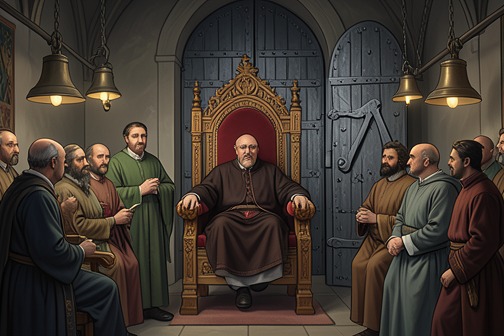
[Macol’s accession and declaration of tyranny](entity:event-recall-event-macol-s-accession-and-d-41792e8b91cc) make a change of ruler look like a change of regime, then expose it as the continuation and intensification of violence. A throne, bells, a bishop, and public acclaim frame the succession as legitimate ceremony; [Macol](entity:character-recall-character-macol-eb661833d4a2)’s own words and the returning guillotines make clear that his promised rule will be harsher than [Macbett](entity:character-recall-character-macbett-d82fd6c896df)’s.
## The transfer of power
The ceremony begins with the removal of Macbett’s body and the arrival of a throne. A guest invites Macol to sit, while more guests enter and some display placards proclaiming, “Macol is always right.” The action replaces a dead ruler’s body with the furniture of sovereignty, making the transfer of power visible before Macol has spoken. The slogan, already phrased as unquestionable doctrine, turns welcome into an early demand for conformity.
Bells sound as Macol stands by the throne and the bishop enters. Macol asks whether the bishop has come to crown him, and the bishop confirms that he has. The exchange establishes the formal, religious aspect of the accession, though the staging does not show the crowning itself. The guests’ acclamations join Macol’s name to [Banco](entity:character-recall-character-banco-9e51f3038982)’s dynasty and to the kingship, placing competing or overlapping claims within the same chorus rather than clarifying them.
## A spectacle of victory
When Macol calls for silence, the crowd is poised to hear its new king. He presents his seizure of power as deliverance: the country, he says, had suffered beneath a yoke, with fresh wounds added day after day, and he has trodden upon the tyrant’s head. As he speaks, a man enters carrying Macbett’s head on a pike. The image gives literal form to Macol’s boast and makes the defeated ruler’s body part of the new ruler’s public case for authority.
The crowd’s response does not settle into uncomplicated celebration. One man says Macbett got what was coming to him; a woman proposes putting out his eyes with knitting needles. Macol answers dissent not with reassurance but with a threat to set soldiers and dogs on those who will not be quiet. The exchange rapidly recasts the cheering assembly as a population already subject to coercion: its voices can acclaim the new king, condemn the dead tyrant, or be suppressed by force.
## The promise of a worse rule
The decisive reversal comes after Macol declares Macbett dead. Rather than promise repair, he announces that his country will have more vices than before and suffer in more varied ways under his succession. The statement overturns the conventional promise implicit in liberation from a tyrant: Macol claims the victory over Macbett, yet openly makes increased misery the program of the government that follows. The crowd answers with murmurs of discontent, amazement, and despair, registering that the speech has transformed apparent triumph into foreboding.
The stage makes that threat concrete. A forest of guillotines appears upstage, recalling their earlier appearance in the play and linking Macol’s reign to an established image of mass execution. The scenery does not merely illustrate an abstract warning; it places the instruments of punishment behind the new sovereign as he speaks. At the end of the announcement, Macol is left alone. The bishop, the only other person remaining, departs dejectedly, leaving the new ruler without the ceremonial company that had attended his arrival.
## Sovereignty without restraint
Macol’s language escalates from national deliverance to personal dominion. He declares that he now has power and invokes the image of pouring concord’s sweet milk into Hell, turning the conventional language of peace into its deliberate negation. His closing claims enlarge the title of king toward emperor of emperors, as if authority could be made absolute by multiplying its names. The progression—from the crowd’s placards, through the threatened use of soldiers and dogs, to the guillotines and the boast of boundless power—shows how public ceremony gives way to openly declared tyranny.
The accession therefore offers no restorative ending to Macbett’s rule. Macol takes the throne amid acclamation, but the announcement exposes succession as a mechanism by which violence continues under a new name. The crowd’s fading response, the bishop’s dejected exit, and Macol’s disappearance into mist leave the promised order unresolved: the new king has claimed supreme power, while the stage has already supplied the image of what that power may bring.